
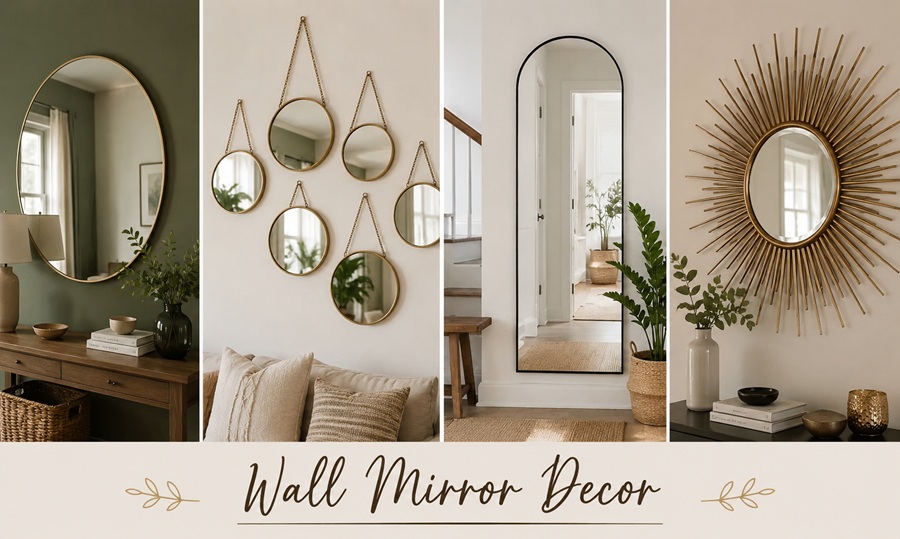

A mirror is one of the few decor pieces that does two jobs at once: it’s functional and it changes how a room looks and feels. Picking the right one comes down to a handful of decisions, size, shape, placement, and frame style, that are easy to get wrong if you’re just guessing. Here’s how to think through each one.
Why Mirrors Matter Beyond Function
Mirrors bounce light around a room, which makes them one of the fastest ways to brighten a dim space without adding more lamps. They also create a sense of depth, which is especially useful in small rooms, narrow hallways, or apartments with limited natural light. Beyond that, a mirror with an interesting frame can act as a piece of art on its own, filling a wall that would otherwise need a painting or print.
In rental homes especially, mirrors are one of the more effective decor upgrades you can make without touching the walls. A large leaning mirror or a hung piece using removable hardware can change the entire feel of a room while remaining fully reversible when you move out.
Types of Wall Mirrors to Consider
Round mirrors
Soften a room full of straight lines and rectangular furniture. They work well above a console table or bathroom vanity, and they tend to feel less formal than a sharp-edged frame.
Rectangular and full-length mirrors
Are the most versatile option and pair naturally with most furniture layouts. A full-length leaning mirror also doubles as a way to check an outfit before heading out, and it doesn’t require any wall mounting at all if you’d rather avoid drilling.
Arched mirrors
Sit between round and rectangular, softer than a hard rectangle but more grounded than a circle. They’ve become popular in bedrooms and entryways over the last few years, partly because they work well both hung on the wall and leaned against it.
Mirror sets or gallery-style groupings
Work when you want visual interest without one large statement piece. These are common in hallways or above a bed frame, and they let you experiment with mixing small variations in shape or frame finish without the commitment of a single oversized piece.
Sunburst and decorative-frame mirrors
Function more like art. They’re best used as a single focal point rather than paired with other wall decor nearby, since the frame itself is usually detailed enough to carry the wall on its own.
Convex and antique-style mirrors
Add a more collected, vintage feel and work well mixed with traditional or eclectic decor, though they’re less practical for actual grooming use given their curved or distorted reflection.
Where to Place a Mirror in Each Room
| Room | Good placement | What it does |
|---|---|---|
| Entryway | Near the door, eye level | Last-look check, brightens a small space |
| Living room | Opposite a window | Reflects natural light across the room |
| Bedroom | Beside a dresser or closet | Practical for getting dressed |
| Dining room | Above a buffet or sideboard | Reflects candlelight, adds depth |
| Bathroom | Above the vanity | Functional lighting and grooming |
| Hallway | Midpoint of a long hallway | Breaks up narrow, blank wall space |
| Home office | Behind or beside the desk | Adds light without glare on a screen |
The general rule for hanging height is to center the mirror around eye level, roughly 57 to 60 inches from the floor to the center of the mirror, unless it’s going above furniture, in which case leave 4 to 8 inches of space between the top of the furniture and the bottom of the mirror. In a room with unusually high or low ceilings, it’s fine to adjust slightly, but the goal should always be a natural sightline rather than a fixed number on a tape measure.
How to Choose the Right Size
A mirror that’s too small for its wall tends to disappear, while one that’s too large can overwhelm the space. As a starting point, a mirror should be about two-thirds the width of the furniture it’s hung above. For a wall with no furniture reference, leave at least a few inches of breathing room on either side rather than letting the mirror stretch edge to edge.
For full-length mirrors used for dressing, height matters more than width. A mirror tall enough to show your full reflection without bending or stepping back, generally 60 inches or taller, is worth prioritizing over a wider but shorter option.
Matching the Mirror to Your Decor Style
- Minimalist or modern: thin metal frames, black or brushed brass, simple round or rectangular shapes
- Traditional: ornate wood or gilded frames, often with carved detailing
- Coastal or relaxed: rattan, rope, or light wood frames
- Industrial: black metal frames, sometimes with visible rivets or a distressed finish
- Boho: sunburst shapes, natural materials, asymmetrical framing
- Transitional: simple wood or matte metal frames without heavy ornamentation, bridging traditional and modern shapes
If your home mixes several styles, a simple frame in a neutral finish is usually the safest way to tie different rooms together without one mirror looking out of place. Matching the mirror’s frame finish to your existing hardware, like cabinet pulls or light fixtures, is also a quick way to make the piece feel intentional rather than randomly selected.
Layering Multiple Mirrors in One Space
A single large mirror isn’t the only option. Grouping several smaller mirrors of similar or varying shapes on one wall can create a gallery effect that works especially well in hallways, stairwells, or above a long console table. When layering multiple mirrors, keep the frame material or color consistent even if the shapes vary, since mixing too many different finishes in one grouping tends to look cluttered rather than curated. Leave consistent spacing between each piece, generally 2 to 4 inches, so the grouping reads as one composition instead of a scattered collection.
Common Mirror Placement Mistakes
Hanging a mirror too high is one of the most frequent issues, especially above furniture, where it starts to look disconnected from the piece below it. Reflecting a cluttered closet, an unfinished wall, or a bathroom door directly in the mirror’s line of sight is another common oversight worth checking before you commit to a spot. Mixing several very different frame finishes in the same sightline, like gold, black, and natural wood all visible from one angle, can also make a room feel unplanned rather than intentional. Choosing a mirror based purely on trend photos without considering the actual wall dimensions is another common misstep, since a mirror that looked great in a wide, bright showroom photo can feel out of scale on a narrower home wall.
Frequently Asked Questions
What’s the best height to hang a wall mirror?
Center the mirror around eye level, generally 57 to 60 inches from the floor. If it’s hanging above furniture, leave a small gap of 4 to 8 inches above the piece instead of measuring strictly from the floor.
Should a mirror face a window or a door?
Facing a window is usually the better choice since it reflects natural light into the room. Facing a door directly is a common decorating rule to avoid in some design traditions, though it’s more of a style preference than a strict requirement.
Can I hang two different mirrors in the same room?
Yes, as long as they share a common thread, like frame color, shape, or general style. Two completely mismatched mirrors visible from the same vantage point tends to look accidental rather than styled.
Do large mirrors make a small room look bigger?
A well-placed large mirror can make a small room feel more open by reflecting light and adding visual depth, especially when placed opposite a window or main light source.
How do I know what size mirror to buy for above a couch or console?
Aim for a mirror that’s roughly two-thirds the width of the furniture below it. Going much wider can make the mirror look oversized for the piece it’s paired with.
Is it better to hang a mirror or lean it against the wall?
Both work, and the choice usually comes down to whether you want a permanent fixture or flexibility to rearrange later. Leaning is common for full-length mirrors and rental spaces, while hanging is better for smaller mirrors placed above furniture where stability matters more.