
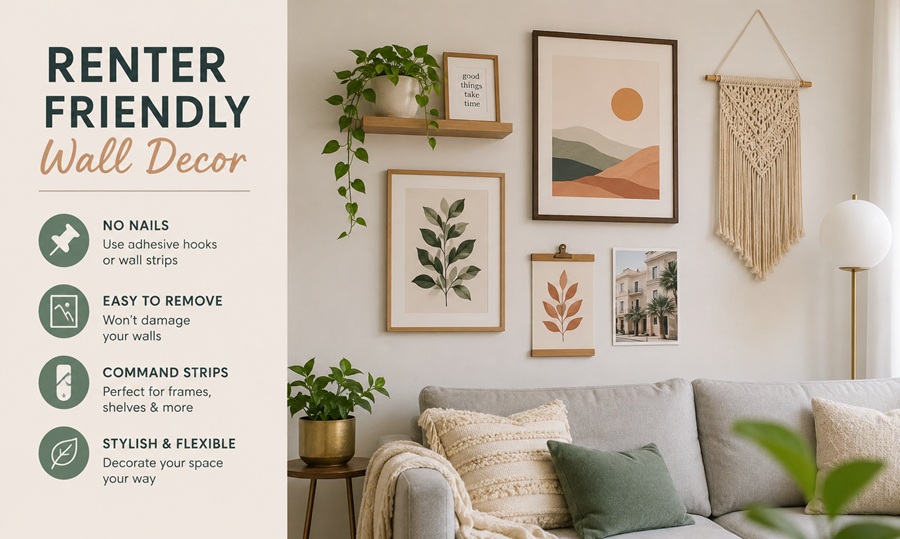

Most lease agreements say the same thing in different words: leave the walls the way you found them. That single clause has talked more renters out of decorating than bad taste ever has. But a blank apartment doesn’t have to stay blank, and it doesn’t have to cost you a chunk of your security deposit either.
Over the last few years, adhesive technology and tension-mounted hardware have finally caught up with what renters actually need. You can now hang gallery walls, mirrors, and even shelving without a single nail hole, and pull it all down again in seconds when you move.
| Quick Answer
The best renter-friendly wall decor uses removable strips, tension rods, or peel-and-stick materials instead of nails. Command strips, washi tape, tapestries, leaning shelves, and removable wallpaper all add personality without damaging walls or violating a lease, and most come off cleanly in under a minute. |
Why Landlords Care So Much About Wall Damage
A single nail hole is a five-minute patch job. A dozen holes from a heavy mirror, or adhesive residue that pulls paint off with it, is a repaint — and that cost usually comes straight out of a deposit. Property managers aren’t being difficult; they’re pricing in labor and materials for the next tenant’s move-in inspection.
Understanding that logic actually helps you decorate smarter. The goal isn’t to avoid decorating, it’s to avoid leaving a mark that costs someone money to fix.
Command Strips and Hooks: The Foundation of Renter Decor
Adhesive strips rated for 5 to 16 pounds have become the default hanging method for a reason. They hold securely on painted drywall, and the stretch-release tab breaks the adhesive bond cleanly when you’re ready to move.
- Check the weight rating on the package and size up if a frame feels borderline heavy
- Press firmly for 30 seconds after applying, then wait an hour before hanging anything
- Pull the tab slowly, straight down and parallel to the wall, never straight out
- Avoid textured or freshly painted walls — both weaken the adhesive bond significantly
- Test on an inconspicuous spot first if your paint is more than a year old
| Tip: Cold weather weakens adhesive strength. If your apartment runs cool in winter, warm the wall slightly with a hair dryer before applying strips for a stronger hold. |
Tension Rods and Leaning Furniture
Not everything needs adhesive at all. A tension rod wedged inside a window frame can hold a curtain of fabric art. A leaning ladder shelf or an oversized floor mirror rests against the wall using gravity and floor space instead of hardware.
Where Leaning Pieces Work Best
Tall, narrow furniture pieces — bookshelves, mirrors, and slim console tables — are naturally suited to leaning against a wall rather than being mounted flush to it. They read as intentional design choices in showrooms for exactly this reason, not as compromises.
| Method | Weight Capacity | Wall Damage Risk | Best For |
|---|---|---|---|
| Command strips | Up to 16 lbs | None if removed correctly | Frames, small shelves, art |
| Tension rods | Varies by rod gauge | None | Curtains, tapestries, fabric art |
| Leaning furniture | N/A (floor-supported) | None | Mirrors, ladder shelves |
| Peel-and-stick wallpaper | N/A | Minimal if primer-tested first | Accent walls, backsplashes |
| Removable putty | Up to 2 lbs | Low, may leave faint oil mark | Lightweight posters, prints |
Fabric, Tapestries, and Soft Wall Art
Textiles solve two problems at once: they add color and texture without weight, and they’re forgiving of imperfect walls. A tapestry hung from a slim curtain rod covers more square footage per dollar than almost any framed print, and it can double as sound dampening in echo-prone rooms.
- Measure the wall space and buy fabric roughly 6 inches wider on each side for a relaxed drape
- Mount a tension or spring rod using the window-frame trick, or two Command hooks rated for the rod’s weight
- Steam or iron the fabric before hanging to remove fold lines
- Layer a smaller textile or macrame piece over the tapestry for visual depth
- Rotate seasonally — fabric art is inexpensive enough to swap without guilt
Peel-and-Stick Wallpaper Done Right
Removable wallpaper has improved dramatically, but success depends almost entirely on wall prep. Glossy or heavily textured paint causes peeling within weeks; a clean, matte or eggshell surface holds for years.
- Wipe the wall down with a mild soap solution and let it dry completely
- Apply in a room with stable temperature and low humidity
- Use a plastic smoothing tool, not a credit card, to avoid scratching
- Start from a corner and work in small sections rather than one long strip
- Store leftover rolls for touch-ups or full removal reference before you move out
Gallery Walls Without a Single Nail
A gallery wall built entirely on Command strips looks identical to one built with nails, provided you plan the layout first. Lay the frames out on the floor, trace the arrangement on butcher paper, tape the paper to the wall, and mark strip placement through the paper before committing to the wall itself.
Budget Snapshot
| Decor Type | Typical Cost Range |
|---|---|
| Command strips (multipack) | $8 – $18 |
| Tension curtain rod | $10 – $25 |
| Tapestry or fabric art | $20 – $60 |
| Removable wallpaper (per roll) | $25 – $45 |
| Leaning floor mirror | $60 – $150 |
Frequently Asked Questions
Will Command strips damage textured or popcorn ceilings and walls?
Yes, textured surfaces are the one place these strips struggle. The adhesive can’t get full contact with the wall, so it either falls off or takes texture with it. Use tension rods or leaning furniture in these rooms instead.
How much weight can a single Command strip actually hold?
Standard strips are rated from 5 to 16 pounds depending on size, but that rating assumes a properly cleaned, smooth painted wall. Always use the number of strips the manufacturer recommends for the frame’s weight, not the minimum.
Can I remove peel-and-stick wallpaper without repainting?
In most cases yes, as long as the wall was properly prepped before application and the wallpaper wasn’t left up for several years. Peel slowly at a 45-degree angle and use a hair dryer on stubborn corners.
What’s the best option for a mirror in a rental?
A leaning floor mirror avoids hardware entirely. If you need a wall-mounted mirror, look for lightweight versions under 10 pounds and use heavy-duty Command strips rated specifically for mirrors.
Do landlords actually check for Command strip residue?
Most move-out inspections check for holes, cracks, and paint damage rather than adhesive residue, since properly removed strips leave nothing behind. Residue usually only appears when strips are pulled incorrectly.
Is washi tape strong enough to hang anything heavier than paper?
Washi tape is best reserved for lightweight items like postcards, photos, and thin prints. For anything with real weight, pair it with a small Command hook rather than relying on tape alone.
Making It Feel Like Home Without the Risk
Renting doesn’t mean living with bare walls until a lease ends. Between adhesive strips, tension hardware, leaning furniture, and fabric art, there’s now a damage-free version of almost every decorating idea that used to require a drill. Start with one wall, test your materials, and build outward from there — your deposit, and your landlord, will never know the difference.