
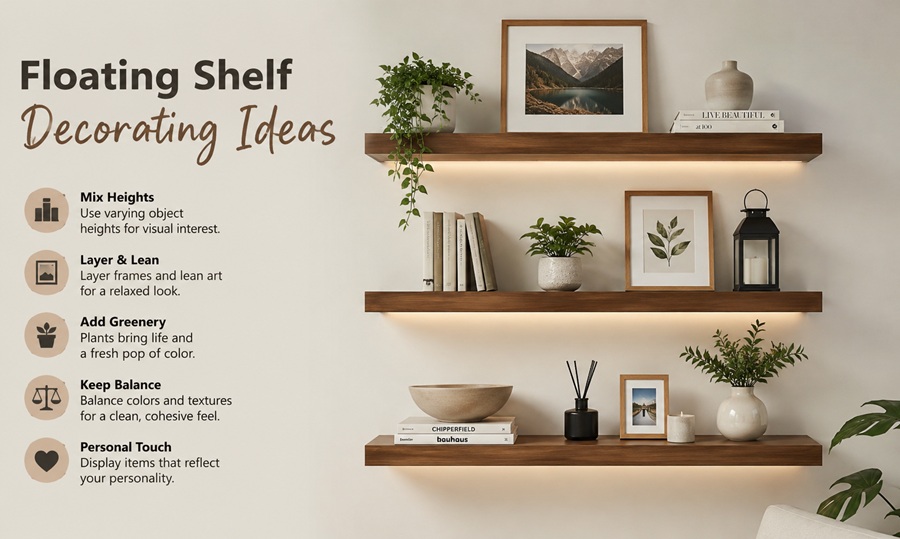

The fastest way to style floating shelves is to group objects in odd numbers, mix heights between three and eight inches, and lean at least one item instead of standing everything upright. Most shelves look cluttered not because they hold too much, but because everything sits at the same height and faces the same direction. A shelf with one tall vase, a short stack of books, and a small plant reads as designed. A shelf with five identical picture frames in a row reads as an afterthought.
Floating shelves have become the go-to solution for renters and homeowners who want the look of built-in storage without the commitment of cabinetry. They work in kitchens, bathrooms, hallways, and living rooms, and because they mount directly to the wall, they free up floor space in a way that bulky bookcases never could. The catch is that an empty floating shelf is easy to install and hard to style well.
The Problem: Why Most Floating Shelves Look Cluttered
Most people treat a floating shelf like a junk drawer with a view. Mail, keys, half-read books, and random knickknacks pile up because there’s no system guiding what goes there. The result is visual noise instead of visual interest.
The second common mistake is spacing. Shelves installed in a perfectly even grid, with identical gaps between each one, tend to feel rigid and impersonal. Real design has a bit of asymmetry to it. A slightly wider gap above one shelf, or a group of two shelves close together with a third set further apart, creates rhythm instead of repetition.
The Solution: A Simple System for Styling Any Shelf
Start by sorting anything you want displayed into three categories: tall and structural (vases, framed art, small sculptures), short and textural (books stacked flat, small bowls, candles), and organic (plants, dried branches, woven baskets). A well-styled shelf usually pulls from all three categories rather than repeating one.
Work in odd-numbered groupings of three, five, or seven items per shelf section. Odd numbers are harder for the eye to organize into a perfect pattern, which is exactly why they look more natural. Vary the height of each item so the overall silhouette rises and falls instead of forming a flat line across the shelf.
Leave at least 20 to 30 percent of each shelf empty. Negative space is what keeps a shelf from reading as busy, and it gives the eye a place to rest between groupings.
Color also plays a bigger role than most people expect. A shelf with five items in five different colors tends to look scattered, while a shelf where two or three items share a tone — even if the shapes and materials differ — feels curated. Pick one or two accent colors from the room’s existing palette and echo them across the shelf styling, rather than treating the shelf as an unrelated display separate from the rest of the room.
Texture matters just as much as color. Pairing a smooth ceramic vase with a woven basket and a rough-hewn wood bowl creates visual interest through contrast, even if every item is a similar neutral tone. This is especially useful on shelves styled in an all-white or all-neutral palette, where texture becomes the main source of visual interest instead of color.
What Is the Right Height for Hanging Floating Shelves?
A common starting point is 12 to 18 inches above furniture like a sofa, console table, or bed, and 60 to 66 inches from the floor for stand-alone wall placement. For kitchen shelves near counters, 15 to 18 inches above the countertop keeps items reachable without crowding your workspace.
How Do You Style Floating Shelves in a Kitchen?
Keep kitchen shelves function-forward. Stack everyday plates, group open-shelf mugs by color, and add one plant or piece of art per shelf to break up the utilitarian look. Avoid overloading them, since kitchen shelves get used daily and need room to add and remove items easily.
Room-by-Room Floating Shelf Ideas
In a living room, floating shelves work well flanking a television or fireplace, styled with a mix of books, framed photos, and one or two plants. Keep the density lighter than a bookshelf so the wall still feels open.
In a bathroom, a single shelf above the toilet or beside the mirror can hold rolled towels, a small plant that tolerates humidity, and a candle. Choose water-resistant materials like sealed wood or metal brackets to avoid warping over time.
In a bedroom, shelves above a headboard or beside a reading chair work well with a small lamp, a stack of current reads, and a framed piece of art leaned rather than hung. In an entryway or hallway, a narrow shelf with hooks underneath doubles as both storage and decor, holding keys, small trays, and a single plant.
In a home office, a single floating shelf above the desk can hold reference books, a small plant, and a piece of art without crowding your workspace the way a full bookcase would. Keep this shelf lighter on decor than other rooms, since visual clutter directly behind a screen or workspace can be distracting during the day.
For a nursery or kids’ room, floating shelves are popular for displaying books cover-out rather than spine-out, making it easier for young children to choose what they want to read. Just be sure to anchor these shelves securely into wall studs, since they’re often installed lower and within reach of curious hands.
Common Floating Shelf Styling Mistakes
The most frequent mistake is overcrowding — trying to display every sentimental item at once instead of rotating pieces seasonally. A shelf that’s 70 percent full almost always looks better than one that’s 100 percent full.
Another mistake is ignoring scale relative to the wall. A tiny 12-inch shelf on a large blank wall looks lost; a shelf that’s too long for a narrow space feels cramped. Measure the wall space first, then choose shelf length so it fills roughly two-thirds of the available width.
Finally, skipping a level or using shelves rated for less weight than what you plan to display leads to sagging or tipping. Check the weight rating before loading a shelf with heavier items like books or ceramics.
Frequently Asked Questions
How many floating shelves should I put on one wall?
Two to three shelves per wall section is typically enough to create visual interest without overwhelming the space. More than that can start to feel like a full bookcase.
Can floating shelves hold heavy books?
Yes, as long as the shelf and mounting hardware are rated for the weight. Solid wood shelves with hidden metal brackets typically support 25 to 50 pounds when installed into wall studs.
What’s the best way to arrange picture frames on a floating shelf?
Lean larger frames toward the back and layer a smaller frame or object in front, rather than lining every frame up in a single row.