
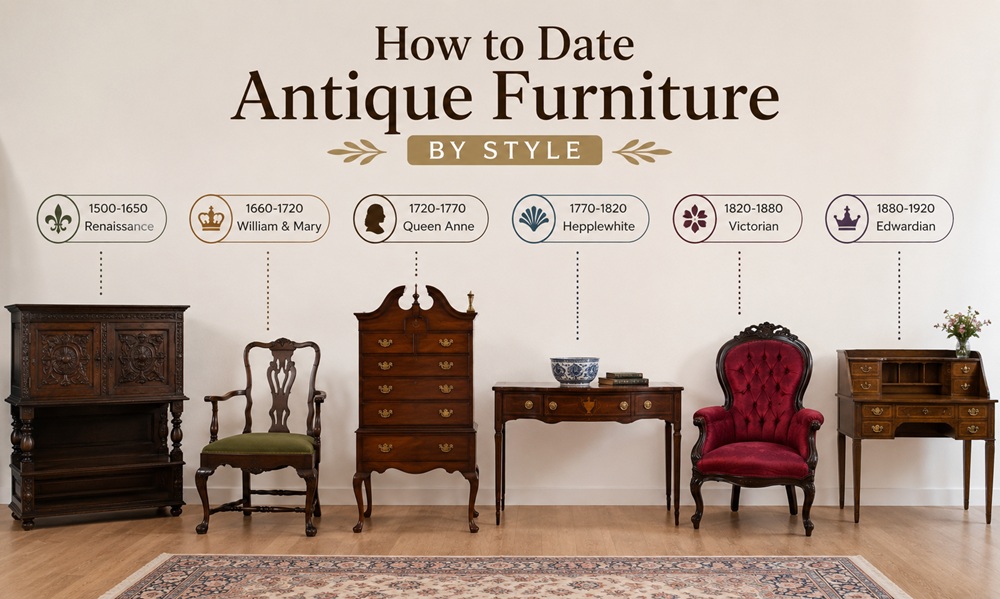

The fastest way to date antique furniture by style is to check three things: the joinery, the materials, and the hardware. Hand-cut dovetails, visible saw marks, and slightly irregular wood grain usually point to pieces built before 1860. Machine-cut joints and uniform screws suggest later production, often after 1900. Matching these construction clues against known design periods, such as Colonial, Victorian, or Mid-Century Modern, narrows the age further. No single feature tells the whole story, but combining construction details with style gives you a reliable estimate without hiring an appraiser.
A Beginner’s Guide to Furniture Style Periods
Every furniture style reflects the tools, materials, and tastes of its era. Learning the rough timeline for major American and European styles is the first step to dating a piece with any confidence.
| Style Period | Approximate Years | Key Features |
| Colonial / Georgian | 1700–1780 | Simple lines, cabriole legs, hand-forged hardware |
| Federal | 1780–1820 | Slender legs, inlay work, brass pulls |
| Victorian | 1837–1901 | Ornate carving, dark woods, upholstered seats |
| Arts & Crafts | 1900–1920 | Straight lines, exposed joinery, oak construction |
| Art Deco | 1920–1940 | Geometric shapes, lacquered finishes, chrome accents |
| Mid-Century Modern | 1945–1969 | Tapered legs, molded plywood, minimal ornamentation |
How to Check Joinery for Age
Pull out a drawer and look at the corners. Hand-cut dovetails are uneven, with pins of slightly different widths and visible tool marks. Machine-cut dovetails, common after the 1860s, are perfectly uniform. Screws offer another clue: pieces from before 1850 often use hand-forged screws with off-center slots, while modern screws have sharp, symmetrical threads. If you see plywood, particleboard, or Phillips-head screws, the piece is almost certainly 20th century.
What Do Hardware and Screws Tell You?
Original hardware, like drawer pulls and hinges, often ages differently than the wood around it. Look for wear patterns that match the surrounding finish. If a pull looks brand new against dark, worn wood, it was likely replaced. Hand-hammered brass or wrought iron typically predates cast, machine-made hardware from factories that became common in the late 1800s.
Can You Date Furniture by Wood Type Alone?
Wood type alone is not enough to date furniture accurately. Mahogany, walnut, and oak were each popular during different periods, but the same woods were reused across eras. Pair the wood species with joinery style, hardware, and finish for a more accurate estimate. Wood can suggest a range, but construction details confirm it.
How Can You Tell If a Finish Is Original?
An original finish usually shows uneven wear, especially on arms, edges, and tops where hands and sunlight made contact over decades. A uniform, glossy coat across the entire piece often signals a refinish or reproduction. Check hidden areas, like the underside of a tabletop, where the original finish is more likely to survive untouched.
Common Mistakes People Make When Dating Furniture
- Assuming a piece is old just because it looks worn or distressed
- Judging age from style alone without checking construction
- Overlooking replaced hardware that doesn’t match the piece’s era
- Mistaking a well-made reproduction for an original antique
- Ignoring maker’s marks, stamps, or labels hidden on drawers and backs
Reproduction furniture has been made for over a century, and skilled makers often replicate period joinery closely. That’s why relying on one clue, like a distressed finish, leads to inaccurate conclusions. Cross-checking multiple details is the only reliable approach.
When Should You Call a Professional Appraiser?
If a piece has a maker’s mark, appears to be pre-1850, or you’re considering insuring or selling it, a certified appraiser is worth the cost. Appraisers can authenticate wood species, confirm construction dates, and provide documentation that supports resale value or insurance claims. For everyday curiosity, the checklist above is usually enough.
Next Steps: Researching Your Piece Further
Once you’ve narrowed down a style period, look for maker’s marks, stamps, or paper labels on the underside of drawers, the back panel, or beneath upholstery. Auction house archives and antique furniture reference books, available at most public libraries, can help match your piece to documented examples. Local antique dealers are also a good resource if you want a second opinion before making any decisions about repair, restoration, or sale.
Frequently Asked Questions
Is Reproduction Furniture Worth Less Than an Original Antique?
Generally, yes. Reproductions typically sell for a fraction of an authentic antique’s value, even when the craftsmanship is excellent. Value depends heavily on provenance, age, and originality, not just appearance.
Should You Refinish Antique Furniture Before Selling It?
In most cases, no. Refinishing removes original patina and can significantly lower value to collectors. Light cleaning is usually safer than stripping and restaining a piece.