
Drive west on Route 4 toward Fair Haven and the rooftops start to change. Barns, churches and plain farmhouses wear gray, green and purple stone, some of it laid before anyone now living was born. This stretch along the Vermont and New York line is slate country, and a few quarries there are still cutting. So when an old roof in this state finally needs work, the question of going back to real slate or switching to a composite look-alike is a practical one. It sits directly over your head.
People weighing that choice usually get the most balanced answer from a crew that installs both. Blue Sky Roofing is a family business whose construction roots in Vermont go back to the 1950s, and its crews lay natural slate, composite slate and cedar alongside their metal and shingle work. A roofer who sells every option has less reason to push one, and that makes the comparison more honest.
Stone That Was Split by Hand
Natural roofing slate is a metamorphic rock that splits along thin, even layers. Quarry workers still cut blocks, split them with a mallet and chisel, trim each piece and punch the nail holes. The finished stone absorbs very little water, under half a percent by most measures. That matters in a place with long winters, because frost has almost nothing to work its way into.
Lifespans of 60 to 125 years are common, and hard slates from this region often reach the top of that range. Color is part of the decision too. “Unfading” slates hold their shade for decades. “Weathering” grays and greens slowly drift toward softer buff and brown tones. That drift is normal, and many owners of old houses value the mottled look it produces.
A Polymer That Learned to Look Like Rock
Composite slate is molded rather than quarried. Most products blend recycled rubber, plastics or engineered polymers with mineral fillers. Manufacturers cast them from molds taken off real slate and make several widths so the roof doesn’t look stamped out.
The practical gains are easy to see.
- The pieces can be cut with a utility knife or saw and nailed without cracking.
- Many products carry a Class 4 impact rating and reach a Class A fire rating when installed over the right underlayment.
- Manufacturer warranties often run around 50 years.
The weak spot is history. Polymer slates haven’t existed long enough to prove a century of service. Some fiber cement slates sold in the 1980s and 1990s cracked and delaminated early, and that is part of why older roofers stay cautious about any material that promises the life of stone.
What the Rafters Have to Say
Weight is often the deciding factor. Natural slate can run from about 700 to more than 1,500 pounds per square (one hundred square feet), depending on thickness. Most composites weigh roughly what architectural asphalt shingles do.
A house that has carried slate for a hundred years was generally framed for it. A house that has only ever held asphalt may not have that margin. Heavy snow loads add to the stone’s own weight, so a sagging ridge or undersized rafters call for a structural check before anyone orders stone. Sometimes the framing settles the question before price or appearance even comes up.
Close Up, From the Road and Fifty Years On
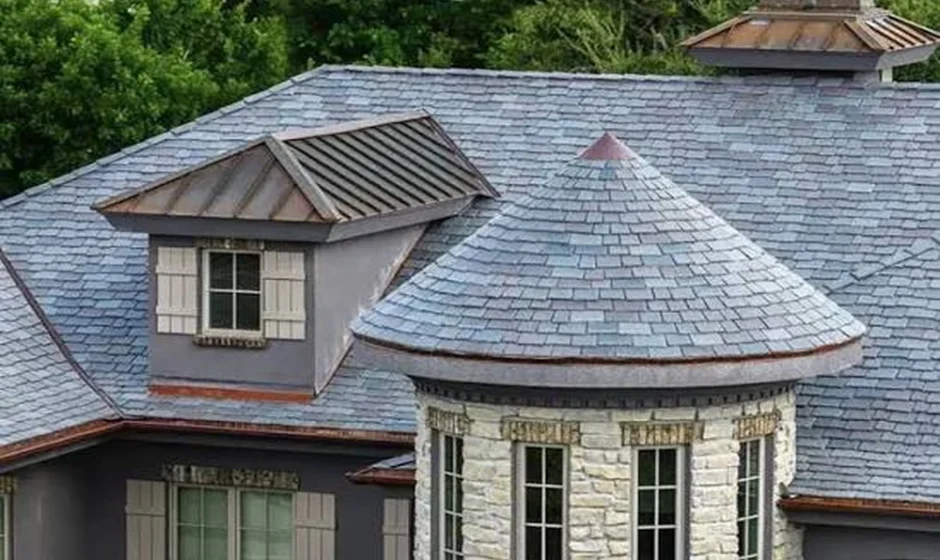
From the sidewalk, a good composite can pass for stone. Look closely at a dormer cheek or the eave line, though, and the even thickness and molded texture tend to give it away. Preservation guidance from the National Park Service says artificial slate isn’t recommended for restoration work because it reads as manufactured, and it notes that some products fade over time.
That opinion carries weight with some local design review boards. If a house sits in a historic district, or the project relies on historic tax credits, expect reviewers to favor real slate. Outside those settings, the choice is purely up to the owner.
January Is the Real Judge
Vermont winters are hard on roofs in a few repeating ways. Freeze and thaw cycles work on anything that holds moisture. Ice dams build at the eaves when attic heat melts snow higher up. Slate sheds snow quickly, sometimes all at once, onto porches, steps and parked cars, so snow guards are worth planning for on either material.
Both roofs depend on what lies underneath them. An ice and water membrane at the eaves and in the valleys does much of the winter work, and ventilation and insulation decide how much meltwater reaches the edge in the first place. Polymer slates also expand and contract with temperature, so installers have to follow the spacing rules closely. Stone barely moves.
Walking, Patching and the Slater’s Ripper
A boot in the wrong place cracks natural slate. Experienced slaters work from hook ladders and roof brackets. To replace a broken piece, they slide a slater’s ripper under it to cut the old nails, then fasten the new slate with a copper strip or hook. Composites tolerate careful foot traffic better. The catch is that a product line may be discontinued, and a replacement piece may not match panels that have spent fifteen years in the sun.
Many leaks blamed on slate actually come from the flashing. Stone can outlast galvanized steel several times over, which is why copper has long been the standard choice around chimneys, valleys and skylights on slate roofs.
When the Old Slate Still Has Life
Before tearing anything off, it is worth finding out whether the existing roof can simply be repaired. Good slate can outlive two or three sets of nails. When the nails rust through, sound pieces slide out of place even though the stone itself is fine. A row of crooked or missing slates can look like the end of a roof when it is really the end of its fasteners.
An experienced slater usually starts by listening. Tapping a loose piece with a knuckle or hammer tells a lot. Healthy stone gives a clear ring, while a dull thud suggests the slate is softening from within. From there the eye takes over, looking for flaking edges, pitted faces or a chalky white bloom on the exposed surface, all signs that weather has started to split the stone apart. The inspection then moves to the metal around the chimney, along the valleys and where the roof meets a wall, because pinholes and lifted seams there cause more leaks than the slate does. It ends in the attic with a flashlight, checking the underside of the boards for old water stains or daylight.
A rule of thumb many preservation guides repeat is that patching stops making sense once about a fifth of the slates on a slope are failing. Below that point, repair and reflashing are usually the better investment. Sound slates salvaged from one slope can also patch another slope on the same house.
The Money Spread Across a Lifetime
Natural slate costs considerably more up front, and skilled slaters are hard to book. Composite material is cheaper, lighter to haul and quicker to install. The NPS points out that tear-off, flashing and labor cost about the same for either material, so the savings from the cheaper product shrink once the full job is priced. The agency argues in its guidance on replacing slate with synthetics that one natural roof can outlast several artificial ones.
Composite installers make a fair counterpoint. Crews move faster when they aren’t lifting stone and replacing broken pieces, and an owner who plans to sell in fifteen years won’t collect on a hundred-year roof. In much of Vermont, though, a sound slate roof is a selling point buyers notice, and that should count in the math too.
Choosing for the House You Have
The decision usually comes from the house itself. An 1880s farmhouse whose framing has carried stone for generations, owned by people who plan to stay, makes a strong case for slate, or for repairing the slate it already has. A 1970s cape with a new dormer and light framing, or an owner who wants the look without the weight, is better suited to a composite. Some Vermont homes split the difference by keeping stone on the main house and putting standing seam metal on the porches and additions.
Whichever way it goes, the roof that lasts in this climate is the one matched honestly to its framing, its winters and its owners’ plans. Brand names and promises matter less than that fit.