
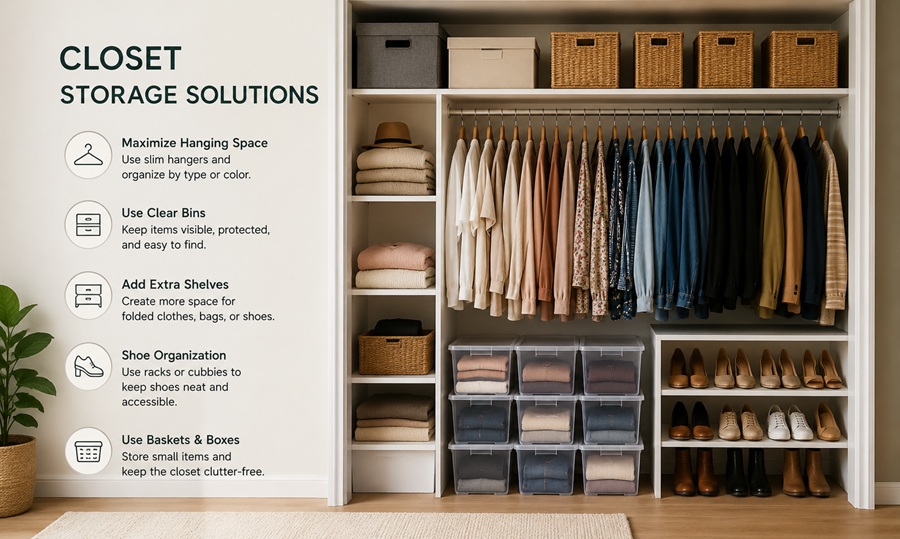

Closet storage solutions range from about $20 for a set of stackable bins to $3,000 or more for a fully custom, professionally installed closet system. Most reach-in closets can be functionally organized for $150 to $400 using modular wire or laminate shelving, without any custom build-out.
How Much Does a Closet System Cost?
Cost depends almost entirely on whether you’re buying components yourself or hiring a company to design and install a built-in system. A DIY approach using retail shelving and bins costs the least but takes more of your own time and measuring. A fully custom system costs the most but is built to your closet’s exact dimensions and typically includes a warranty and installation.
| Tier | Cost Range | Best For |
| Budget bins & baskets | $20–$100 | Renters, quick fixes, small closets |
| Modular wire/laminate shelving | $150–$400 | Reach-in closets, DIY installers |
| Semi-custom closet kits | $500–$1,200 | Walk-in closets, moderate customization |
| Fully custom closet system | $1,500–$3,000+ | Large walk-ins, long-term homeowners |
What Is the Cheapest Way to Organize a Closet?
The cheapest route is working with what’s already installed. Add stackable bins, over-the-door organizers, and a tension rod for a second hanging row. This approach usually runs under $100 and can be done in an afternoon without tools, making it a solid option for renters who can’t modify the closet permanently.
Option 1: Budget Bins and Baskets
Clear stackable bins work well for folded items like sweaters and off-season clothes, since you can see contents without opening every container. Fabric baskets suit shelves where visibility matters less, like linens or accessories. This tier is entirely renter-friendly and requires no drilling or permanent changes.
- Clear bins for folded clothing and off-season items
- Fabric baskets for shelves and open cubbies
- Over-the-door shoe or accessory organizers
- Tension rods for adding a second hanging tier
Option 2: Modular Wire or Laminate Shelving
This is the most common upgrade for reach-in closets, and most home improvement stores sell kits that can be cut or configured to fit standard closet widths. Wire shelving is cheaper and better for shoes and ventilated storage, while laminate shelving looks more finished and holds heavier folded stacks without sagging.
How Do I Organize a Small Closet?
Use double-hang rods to split one tall hanging section into two shorter ones — this alone can double usable hanging space in a small reach-in closet. Add a shelf above the rod for bins, and use the floor only for shoes or a small hamper, since floor clutter is what makes small closets feel chaotic.
Option 3: Semi-Custom Closet Kits
Semi-custom kits sit between DIY shelving and full custom builds. They come in standard modules — drawers, shoe cubbies, hanging sections — that you configure to your closet’s layout. Most can be installed in a weekend without professional help, and they look considerably more finished than wire shelving.
Option 4: Fully Custom Closet Systems
A custom system is built to the exact dimensions of your closet, often with a designer visit to plan the layout around your specific wardrobe. This tier makes the most sense for larger walk-in closets or for homeowners planning to stay in the home long enough to make the investment worthwhile.
Shoe Storage Solutions
Shoes are one of the hardest categories to store well because they don’t stack cleanly and take up floor space fast. Angled shoe shelves fit more pairs into less depth than flat shelves, and a hanging shoe organizer on the closet door works well for smaller collections without using any floor space at all.
Recommendations by Situation
- Renting or moving soon: bins, baskets, and tension rods only
- Small reach-in closet: double-hang rods plus modular wire shelving
- Walk-in closet on a moderate budget: semi-custom kit with drawers
- Long-term homeowner with a large closet: fully custom built-in system
Frequently Asked Questions
Is It Worth Paying for a Custom Closet System?
For a large walk-in closet in a home you plan to stay in for several years, yes — custom systems maximize every inch and tend to hold up longer than retail shelving. For a small reach-in closet or a rental, a modular or budget approach usually delivers similar function for a fraction of the cost.
How Do I Organize a Closet With No Shelves?
Freestanding shelving units or a small dresser inside the closet can substitute for built-in shelves. Over-the-door organizers and hanging fabric shelves also add storage without requiring any permanent installation, which works well in older homes or rentals.
Maximizing a Walk-In Closet Layout
Walk-in closets often waste space in the middle of the floor, since most people default to lining shelving along the perimeter walls only. Adding a central island, even a small one with drawers, uses that dead space for folded items and can double as a place to set down clothes while getting dressed.
Lighting matters more in walk-in closets than people expect, especially for closets without windows. A single overhead fixture often leaves the corners dim, making it hard to tell colors apart. Adding a secondary light source, like an LED strip under a shelf, solves this cheaply.
Maintaining an Organized Closet Long-Term
Any storage system, no matter how well-designed, drifts back toward clutter without a maintenance habit. A quick 10-minute reset at the start of each season — returning misplaced items, donating what hasn’t been worn, and re-folding bins that have gotten messy — keeps a closet system working long after the initial setup.
DIY Installation vs. Professional Installation
Modular wire and laminate shelving kits are designed for DIY installation with basic tools, typically a drill and a level, and most can be completed in an afternoon. Fully custom systems, on the other hand, are almost always professionally installed as part of the purchase price, since precise measurements and anchoring into studs are critical for a system that will hold significant weight over many years.
Renter-Friendly Closet Upgrades
Renters can still make meaningful closet improvements without permanent changes. Tension-mounted shelving and rods, adhesive hooks rated for the weight they’ll hold, and freestanding shelving units all add function without drilling into walls, and everything can move with you at the end of a lease.