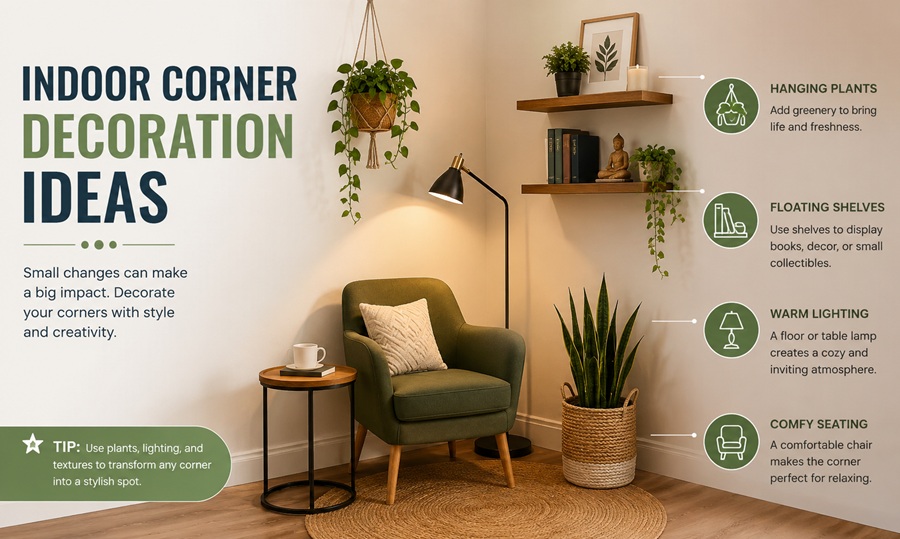

An empty corner usually needs one of four things: a plant, a light source, a small piece of furniture, or artwork sized for the angle. Corners feel awkward mostly because they’re diagonal, which makes standard rectangular furniture sit oddly. Choosing pieces designed for that angle, like a round plant stand or a corner shelf, solves most of the problem.
What Is Good for an Awkward Corner?
The best corner fillers are things that don’t need to align with a wall on both sides — plants, floor lamps, round tables, and freestanding art all work because they read as intentional regardless of the exact angle. Bulky rectangular furniture, on the other hand, almost always leaves an odd gap.
Category 1: Plants
A tall floor plant is one of the most reliable corner fixes because it fills vertical space without needing to match anything else in the room. In lower-light corners, a snake plant or ZZ plant tolerates indirect light well. In brighter corners near a window, a fiddle leaf fig or rubber plant adds more visual height.
Category 2: Lighting
A floor lamp is often the single best solution for a dark, empty corner, especially in living rooms where overhead lighting leaves the edges of the room dim. Arc lamps work well over a seating area, while a simple tripod or torchiere lamp fits tighter corners without needing extra floor clearance.
Category 3: Furniture
A small accent chair angled into the corner, rather than pushed flush against both walls, creates a reading nook without needing much square footage. A round side table or a corner shelf unit also works, since curved or angled pieces naturally fit the diagonal space better than square furniture does.
Category 4: Art and Wall Decor
Corner shelves designed to wrap around the angle can display books or small objects and pull the eye upward. A single piece of tall, narrow art on one wall of the corner — rather than trying to center something across both walls — usually looks more deliberate.
How Do You Fill an Empty Corner?
Start by identifying whether the corner needs function or just visual interest. A corner near a reading chair benefits from a lamp and small table. A purely decorative corner in a hallway or living room can be filled with a plant or art alone, without adding furniture that isn’t needed.
- Tall floor plant for vertical interest
- Floor lamp for dark or underlit corners
- Angled accent chair for a mini reading nook
- Corner shelving unit for books or display objects
- Tall mirror to bounce light and visually expand the space
- Small round table paired with a plant or lamp
- Wall-mounted art sized for a narrow vertical space
- Curtain-and-chair setup to create a defined nook
Living Room Corner Examples
In a living room, corners often sit behind a sofa or across from the main seating area. A floor plant paired with a floor lamp is a low-effort combination that works in almost any living room style, from traditional to minimalist. For a more furnished look, an accent chair with a small side table turns the corner into usable seating.
Bedroom Corner Examples
Bedroom corners are a natural spot for a reading nook — a chair, a small lamp, and maybe a narrow bookshelf. Alternatively, a vanity or slim desk fits well in a bedroom corner that isn’t being used for much else, especially in apartments without a dedicated office space.
Dining Room and Entryway Corner Examples
In dining rooms, a corner hutch or a tall plant near the table adds height without competing with the table itself. In entryways, corners often work best left mostly open with just a plant or umbrella stand, since foot traffic makes furniture placement trickier.
Frequently Asked Questions
Should You Always Put Furniture in a Corner?
No. Some corners look better with just a plant, art, or nothing beyond a coat of paint that matches the rest of the wall. Forcing furniture into every corner can make a room feel more cluttered rather than more finished.
What Plants Work Best in Dark Corners?
Snake plants, ZZ plants, and pothos all tolerate low, indirect light and are common choices for corners that don’t get much natural sunlight. They also require relatively little maintenance, which makes them a practical pick for a spot that’s easy to forget about.
Home Office Corner Examples
A corner desk setup is one of the most practical uses of unused corner space, especially in apartments without a dedicated office room. A compact L-shaped or corner desk fits into the angle naturally, and adding a shelf above it keeps supplies organized without taking up additional floor space.
Kitchen and Dining Corner Ideas
Kitchen corners are often filled with a small bistro table or a corner banquette in homes without a separate dining room. A tall plant or an open shelf for cookbooks and dishware also works well in kitchen corners that don’t have room for seating, adding both storage and visual interest.
Measuring Before You Buy
Corner spaces are deceptively tricky to measure because the usable depth changes depending on how far into the room you’re willing to place furniture. Measure both wall lengths and the diagonal distance from the corner point before shopping, since a piece that looks right in a showroom can end up blocking a doorway or walkway once it’s home.
Using Curtains to Define a Corner Nook
A ceiling-mounted curtain track that wraps around a corner is an easy way to create a defined, semi-private nook without any construction. This works especially well for a reading corner or a small workspace in a studio apartment, where the curtain can close off the area visually without permanently dividing the room.
Corner Decor on a Budget
A meaningful corner update doesn’t require a big spend. A single plant in a budget-friendly ceramic pot, a secondhand chair reupholstered or left as-is, or a floor lamp from a discount retailer can transform an awkward corner for under $100 in most cases.