
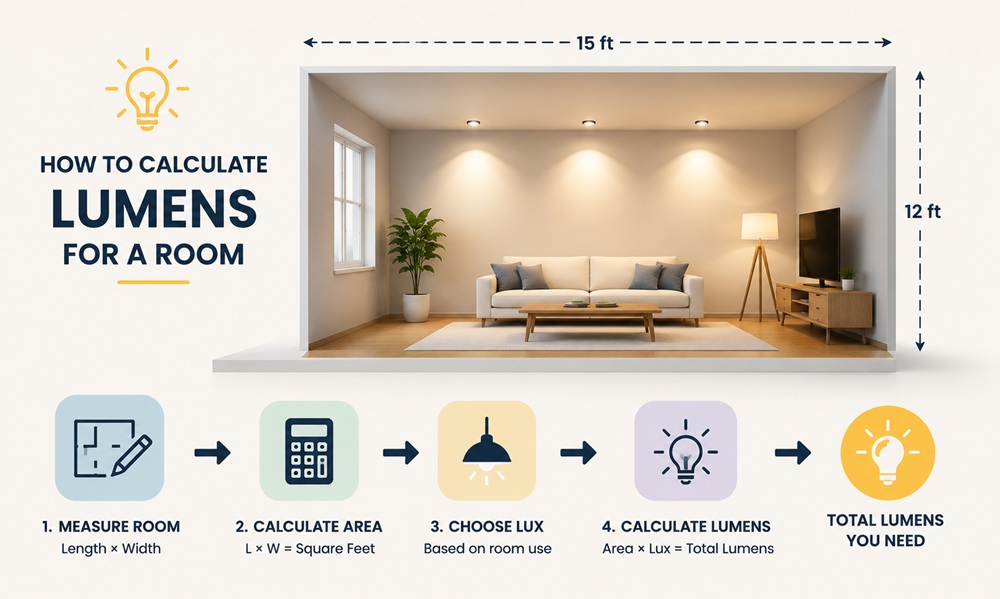

To calculate lumens for a room, multiply the room’s square footage by the foot-candles recommended for that room type. A living room needs about 10-20 foot-candles, so a 200 square foot living room needs roughly 2,000 to 4,000 lumens total. Kitchens and workspaces need more light, often 30-40 foot-candles, while bedrooms can get by with less.
That’s the quick math. But getting lighting right in a real room takes a bit more than one formula, especially once you start mixing lamps, ceiling fixtures, and natural light. Here’s how to work through it step by step.
Lumens Checklist by Room Type
Use this as a starting point, then adjust based on ceiling height and how much natural light the room gets.
- Living rooms: 1,500-3,000 lumens (10-20 foot-candles)
- Bedrooms: 1,000-2,000 lumens (10-15 foot-candles)
- Kitchens: 3,000-4,000 lumens for general light, plus 400-500 lumens per task area
- Bathrooms: 2,000-3,000 lumens, brighter near mirrors
- Home offices: 3,000-4,000 lumens for focused work
- Hallways and closets: 500-1,000 lumens
- Garages and workshops: 5,000-7,500 lumens for detailed tasks
The Simple Lumens Formula
The basic calculation is: Room square footage x recommended foot-candles = total lumens needed.
To measure your room, multiply length by width in feet. A 12×15 room is 180 square feet. If that’s a living room, you’d aim for 10-20 foot-candles, which puts your target between 1,800 and 3,600 lumens.
Once you know your target, add up the lumen output of the bulbs you’re considering. Bulb packaging lists lumens directly now instead of watts, so a “60-watt equivalent” LED typically produces about 800 lumens. Three of those bulbs in a fixture gets you to 2,400 lumens, right in range for a mid-sized living room.
What Is a Lumen, Exactly?
A lumen measures the total amount of visible light a bulb produces. It’s different from a watt, which measures energy use, not brightness. This distinction matters because LED bulbs produce far more lumens per watt than older incandescent bulbs, so comparing bulbs by wattage alone can be misleading.
How Many Lumens Do You Need for a Living Room?
Most living rooms need 1,500 to 3,000 total lumens, spread across multiple sources rather than one overhead fixture. A single ceiling light rarely creates comfortable, even lighting on its own. Combining a ceiling fixture with a floor lamp and a table lamp tends to look better and function better than one bright source overhead.
Can You Over-Light a Room?
Yes, and it’s a common mistake. Too many lumens in a small space can feel harsh and clinical rather than cozy. If a room feels more like a retail store than a living space, dimmable fixtures or lower-lumen bulbs usually fix it. Dimmer switches also let you adjust brightness for different times of day without buying new bulbs.
Adjusting for Ceiling Height and Natural Light
Standard lumen recommendations assume an 8-foot ceiling. Rooms with vaulted or 10-foot-plus ceilings often need 10-20% more lumens because light has farther to travel and spreads out more before reaching eye level.
Natural light matters too. A room with large south-facing windows may need less artificial lighting during the day but still needs full lumen coverage for evenings. If you’re calculating lumens for a room you mostly use at night, don’t discount the total based on daytime brightness.
Layering Light for Better Results
Lighting designers often talk about three layers: ambient (general room lighting), task (focused light for reading or cooking), and accent (highlighting art or architectural features). Splitting your total lumen target across these layers, rather than relying on one ceiling fixture, tends to produce a room that feels warmer and more functional.
For a home office needing 3,500 lumens, that might look like a 2,000-lumen ceiling fixture plus a 1,000-lumen desk lamp plus a smaller accent light. This approach also gives you more control, since you can turn off task lighting when it’s not needed.
Common Mistakes When Calculating Lumens
People often grab whatever bulb is on sale without checking the lumen output, which leads to rooms that are either too dim to use comfortably or too bright to relax in. Another common issue is forgetting that dark wall colors and low ceilings absorb more light, so rooms with these features may need lumens toward the higher end of the recommended range.
Bulb color temperature also affects how bright a space feels, even at the same lumen count. Cooler light (4000K-5000K) tends to feel brighter and more energizing, which works well in kitchens and workspaces. Warmer light (2700K-3000K) feels cozier and suits living rooms and bedrooms.
Quick Reference Table
| Room Type | Foot-Candles Needed | Approx. Lumens (150 sq ft room) |
| Living Room | 10-20 | 1,500-3,000 |
| Kitchen | 30-40 | 4,500-6,000 |
| Bedroom | 10-15 | 1,500-2,250 |
| Home Office | 30-40 | 4,500-6,000 |
| Bathroom | 20-30 | 3,000-4,500 |
Once you’ve calculated your target lumens, check the label on any bulb or fixture you’re considering. Most manufacturers list lumen output clearly now, which makes matching bulbs to your room’s needs far simpler than it used to be.
Smart Bulbs and Adjustable Lumens
Smart bulbs add another layer of flexibility to lumen planning, since many models let you adjust brightness on a scale rather than committing to a fixed output when you screw in the bulb. This is especially useful in multi-purpose rooms, where a home office might need close to 4,000 lumens for daytime work but only a fraction of that for evening relaxation. Instead of buying separate fixtures for each use case, a dimmable smart bulb rated near the top of your target range covers both scenarios with one purchase.
When shopping for smart bulbs, check the maximum lumen output listed on the product, not just the “equivalent wattage,” since some budget smart bulbs advertise a wattage equivalent without hitting the true lumen number expected of that class. Pairing smart bulbs with a simple app or voice assistant also makes it easier to fine-tune brightness by trial and error once the fixture is installed, which can save you from returning bulbs that turn out too bright or too dim for daily use.
Putting the Numbers Into Practice
Lighting a home well rarely comes down to a single number. Once you’ve calculated the general lumens needed for a room, walk through it at different times of day and adjust from there. A kitchen that felt perfectly lit on a bright afternoon might feel dim once the sun goes down, which is a sign to add a secondary light source rather than replacing the primary fixture with something far brighter than the room actually needs during the day.