
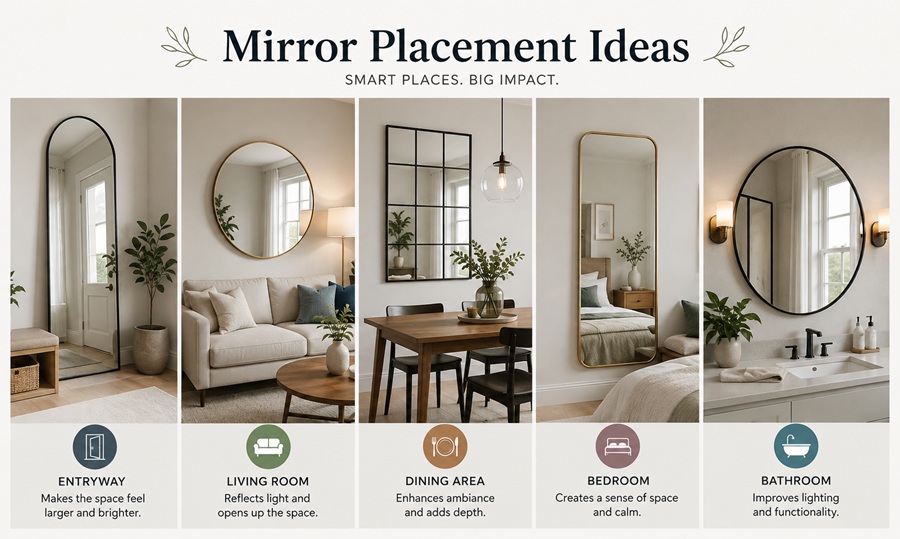

A mirror is one of the few decor items that does actual physical work in a room. Hang it wrong and it just reflects a wall. Hang it right and it can make a room feel a third larger, pull daylight into a dim corner, or fix a layout problem no amount of furniture rearranging could solve.
Designers treat mirror placement as a lighting decision first and a decorating decision second. That mindset shift changes everything about where a mirror actually belongs.
Start With the Light Source, Not the Wall
The single biggest mistake in mirror placement is choosing a wall based on what looks empty rather than what’s across from a window. A mirror positioned directly opposite a window bounces daylight back into the room, effectively doubling the light source for free.
- Stand where you want more light and look for the nearest window across the room
- A mirror at a slight angle to the window catches more ambient light than one perfectly parallel
- Avoid placing a mirror where it reflects mainly a blank wall or the back of furniture
- In north-facing rooms with limited natural light, this placement matters even more
Room-by-Room Placement Guide
Entryways and Hallways
A mirror near the front door serves double duty: a last-look-before-you-leave function and an immediate sense of openness the moment someone walks in. In narrow hallways, a long vertical mirror on one side wall visually pushes the walls apart.
Living Rooms
Over a sofa or console table, a mirror should sit roughly 4 to 6 inches above the furniture and be no wider than two-thirds of the piece beneath it. Oversized leaning mirrors work well on an empty accent wall, particularly in rooms with high ceilings.
Bedrooms
Full-length mirrors belong on the inside of a closet door or beside a dresser, out of direct line of sight from the bed. Some design traditions, including feng shui practice, avoid placing a mirror facing the bed directly; whether or not that resonates with you, off-axis placement also just tends to look more intentional.
Dining Rooms
A mirror behind a dining table catches candlelight and pendant light, making the whole table setting feel more layered in the evening. Position it centered above a sideboard or buffet, not directly behind a chair where it competes with a place setting.
| Room | Ideal Height | Common Mistake |
|---|---|---|
| Entryway | Eye level, centered | Hanging too high to be functional |
| Living Room | 4–6 in above furniture | Sizing wider than the console beneath it |
| Bedroom | Full-length, floor to near-ceiling | Facing directly toward the bed |
| Dining Room | Centered above sideboard | Blocking it with tall chair backs |
| Bathroom | Centered above sink, eye level | Hanging too low for taller household members |
Making Small Rooms Feel Larger
The size-illusion trick works best with mirrors that span most of a wall rather than small decorative ones. A floor-to-ceiling mirror on the shortest wall of a small room tricks the eye into reading the space as roughly double its actual depth.
- Identify the room’s shortest or most closed-off wall
- Choose a mirror that spans at least 60 percent of that wall’s width
- Keep the frame minimal or frameless so the reflection reads as an extension of the room, not a framed object
- Pair with light-colored walls so the reflected color matches the real one
| Note: Frameless or thin-frame mirrors create a stronger size illusion than heavy ornate frames, which draw the eye to the object itself rather than the reflected space. |
What to Avoid
- Two mirrors facing each other, which creates a disorienting infinite reflection
- Mirrors facing a cluttered closet, laundry pile, or unmade bed
- Placing a mirror where it reflects a television screen and causes glare
- Mounting heavy mirrors on drywall without proper anchors rated for the weight
Common Mirror Placement Questions
What height should a mirror be hung at?
For most rooms, center the mirror at average eye level, roughly 57 to 65 inches from the floor to the mirror’s center point, adjusting slightly for the height of nearby furniture.
Should a mirror ever face a window directly?
Yes — this is one of the most effective placements for brightening a room, since it reflects daylight back into the space rather than absorbing it.
Is it bad luck to have a mirror facing the bed?
Some traditions, like feng shui, advise against it, but there’s no universal rule. If it bothers you or affects your sleep, reposition it or add a cover at night.
How big should a mirror be over a console table?
Aim for a width that’s about two-thirds to three-quarters of the table’s width, so it feels proportionate rather than overwhelming the furniture beneath it.
Can mirrors help a room with no windows at all?
Yes, a mirror reflecting a lamp or light fixture can still amplify existing artificial light, though the effect is less dramatic than reflecting natural daylight.
The Takeaway
Good mirror placement is really a light and space exercise disguised as decorating. Find your best light source, respect the room’s proportions, and avoid the handful of common missteps above, and a single mirror can do more for a room than an entire furniture rearrangement.